Tuesday, October 22, 2019

Pennsylvania Political Geography II: Bidenland


“Bidenland” is a term coined by Brandon Finnigan of the Decision Desk HQ website to describe a region of small, blue-collar cities in east-central and northeastern Pennsylvania.  It is less urbanized than the Philadelphia metro area to its south, but more urbanized than central Pennsylvania to its west.  It tends to be evenly divided between the two parties. 


The Blue Mountain line divides Bidenland into two regions: the anthracite coal region, from the city of Scranton (birthplace of the former vice president) southwestward to Northumberland and far northern Dauphin counties, and a string of counties to the south and east of the coal region, from Reading through the Lehigh Valley to the Poconos, that have become exurbs of Philadelphia and New York. 


Anthracite coal, which gives the coal region its name, is the hardest and purest form of coal, being over 90% carbon, and almost all of America’s anthracite reserves are in this part of Pennsylvania.  (Other coal-mining areas produce bituminous coal, which is 80-90% carbon.)  The heyday of coal mining in this area was in the late 1800s and early 1900s, coinciding with the great wave of immigration from southern and eastern Europe.  This gave the area a high concentration of “ethnic” white residents; for example, Luzerne (loo-ZERN) County is the only county in the country where Polish is the most common ancestry, and Schuylkill (SKOOK’ll) County has one of the highest concentrations of Lithuanian-Americans in the country.  Unfortunately, the coal industry declined after World War II, and the area has struggled to find a role in the post-industrial economy.


The coal region can be usefully divided into two sub-regions.   The first is the Wyoming Valley, consisting of Lackawanna (LOCK-a-WAHN-a), Wyoming, and northern and central Luzerne Counties.  The Wyoming* Valley is centered around the cities of Scranton and Wilkes-Barre.  In 1900, this area was second only to Philadelphia and Pittsburgh as a population center in Pennsylvania but has lost ground as the coal industry declined.  Lackawanna County, which contains Scranton, is a Democratic stronghold, voting Republican for President only in the landslides of 1956, 1972, and 1984.  Scranton is the base of the Casey family (Bob Sr., who was governor from 1987-95, and Bob Jr., who has been U.S. Senator since 2007) and of William Scranton, a governor in the 1960s who led the moderate opposition to Barry Goldwater at the 1964 Republican convention.  Scranton politicians might have been even more successful if Ernie Preate and Kathleen Kane, two popular state attorneys general from the city, hadn’t ensnared themselves in scandal before they could seek higher office.

The second part of the coal region consists of Schuylkill County and surrounding parts of nearby counties (including the communities of Hazleton, Shamokin, and Berwick); call it Greater Schuylkill County.  It is more rural, and therefore more conservative, than the Wyoming Valley, but it still had a number of Democratic strongholds until the rise of Donald Trump, who gained more votes (in percentage terms) compared to Mitt Romney in Schuylkill County than any other Pennsylvania county.  The most prominent recent politician from the area, Lou Barletta, was a former mayor of Hazleton and Congressman whose blue-collar persona and staunch opposition to illegal immigration presaged Trump, but who was unable to replicate his success in a 2018 challenge to Senator Casey.  Another prominent politician from the area is Tim Holden, a moderate Democrat who served in Congress for twenty years but lost a primary after his district was redrawn to include more liberal parts of Bidenland.  Lest you feel too sorry for them, Barletta is now a lobbyist for Italian food merchants and Holden is on the state Liquor Control Board, both of which sound a lot more fun than serving in Congress, especially if free samples are involved.

The most heavily populated part of Bidenland- in fact, the most populous metropolitan area in the state outside Philadelphia and Pittsburgh- is the Lehigh Valley, consisting of Lehigh, Northampton, and southern Carbon counties and centered around the cities of Allentown and Bethlehem.  In many ways, it is a microcosm of the state as a whole, with declining industrial areas (just ask Billy Joel), growing urban and suburban areas, a burgeoning Hispanic and Middle Eastern population, and conservative rural areas in close proximity to each other.  Traditionally, Lehigh County (which contains Allentown and part of Bethlehem) was Republican, while Northampton County (which contains Easton and most of Bethlehem) was Democratic.  More recently, they have begun to switch places, with Lehigh becoming more Democratic and Northampton flipping to Donald Trump in 2016. 

The area’s provincialism (another trait, I’ll admit, that it shares with the state as a whole) means that its politicians usually get outvoted by competitors from Philadelphia or Pittsburgh when running for statewide office.  The most successful Lehigh Valley politician of recent years is the exception that proves the rule.  Pat Toomey**, then the area’s congressman, challenged and nearly defeated then-Senator Arlen Specter in the 2004 Republican primary, by which time the state’s Republican base had grown so frustrated with Specter’s moderation that they would have embraced any viable challenger, whether he came from Allentown or Outer Mongolia.  Toomey’s preparations for a rematch drove Specter to switch parties, leaving him as the only Republican standing in time for the 2010 wave.  Toomey’s appeal, at least initially, was more ideological than geographic.

The northeastern corner of Pennsylvania- Wayne, Pike, and Monroe counties- is the Poconos.  A rural backwater for most of its history, the area’s population quadrupled from about 70,000 in 1950 to about 280,000 in 2010 as it developed its tourist industry and ties to New York City and New Jersey.  Like most of rural Pennsylvania, it was once solidly Republican (Wayne County was one of only four Pennsylvania counties to stick with Barry Goldwater in 1964).  In the 1990s and 2000s, Monroe County went Republican by increasingly small margins (George W. Bush carried it by only four votes in 2004) before going for Barack Obama handily in 2008.  Pike and Wayne counties, while still red, were closer than before.  By 2016, though, Pike and Wayne counties cast over sixty percent of their vote for Donald Trump, while Hillary Clinton carried Monroe County by less than a percentage point.

Political and Demographic Trends

Below are charts showing the presidential vote in the coal region (which I will define as Carbon, Columbia, Lackawanna, Luzerne, Northumberland, Schuylkill, and Wyoming counties), the exurbs (Berks, Lehigh, Monroe, Northampton, Pike, and Wayne counties), and Bidenland as a whole, both in absolute terms and compared to the national popular vote:


Two broad conclusions stand out from this chart.  First, Bidenland is usually a bellwether.  In the years covered, it was within five percent of the national popular vote with only two exceptions: 1964 and 2016.  Second, until recently, the coal region was reliably more Democratic than the exurbs.  This changed in 2008, when Obama did better in the exurbs than in the coal region, and even more dramatically in 2016, when Trump carried the coal region handily.  Let’s take a closer look at how individual counties voted, beginning with the four largest exurban counties:

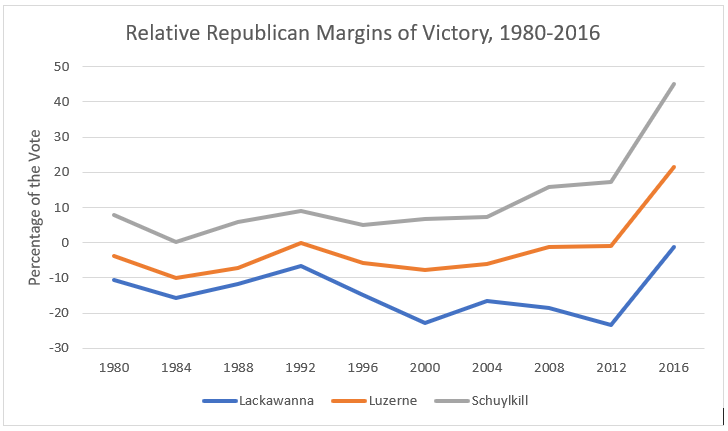
In the 1980s, three of the four counties were Republican-leaning, as rural and suburban areas had grown relative to the cities of Reading and Allentown.  During the 1990s and 2000s, all three counties (the exception being Northampton, which was traditionally Democratic) shifted toward the Democrats as the party gained ground in suburban areas nationwide.  In the 2012 and 2016 cycles, though, Republicans gained in all four counties.  Even in Monroe County, which had gone from being largely rural to suburban and has a growing Hispanic population, Hillary Clinton won by less than her margin in the national popular vote.  Here’s a similar comparison for the three largest coal region counties:


The changes here are even more dramatic.  Lackawanna County, containing the city of Scranton and the most urbanized of the three, was always Democratic-leaning and was getting steadily more Democratic from the 1980s until 2012, but Hillary Clinton barely won the county in 2016.  Schuylkill County, the most rural of the three, was always Republican-leaning (even in 1996, when it voted for Bill Clinton, it did so by a smaller margin than the national popular vote), but Republican margins began increasing after the turn of the millennium, culminating in Donald Trump getting over sixty-nine percent of the vote there in 2016.  Luzerne County, in between the two, was slightly to the left of the nation from 1980 to 2012, but swung hard to Trump in 2016.

Finally, I would be remiss not to mention the population shift within Bidenland.  From 1950 until the most recent census, the coal region’s population declined slightly, from just over one million to just under one million.  The population of the exurbs, however, almost doubled, from about 700,000 to over 1.3 million.  So, the coal region, where Democratic fortunes tanked in 2016, is losing clout, but Republicans are also gaining in the growing areas around Reading, the Lehigh Valley, and the Poconos.  If Democrats want to regain their edge in Pennsylvania, they will have to reverse these trends.


*The state of Wyoming gets its name from this area, indirectly.  A poem (“The frontier maid, or A tale of Wyoming”) was written about conflict between Indians and settlers in this area during the American Revolution and was popular at the time the Wyoming Territory was established, inspiring the name.


**In the interest of full disclosure, I worked on Senator Toomey’s official staff from 2011-13.


Monday, October 21, 2019

Pennsylvania Political Geography, I: Introduction

Via Wikipedia, a map of Pennsylvania with counties labeled.  

Greetings from the center of Presidential politics, rural Pennsylvania.  

Most political observers know that Donald Trump was the first Republican since 1988 to carry the Keystone State, but fewer realize that Trump’s victory broke an even longer-standing pattern.  Pennsylvania was once one of the most Republican states in the Union, voting for the GOP in every election between the Civil War and New Deal (except 1912, when it went for Theodore Roosevelt’s third-party bid), even sticking with Herbert Hoover in 1932.  Franklin Roosevelt carried the state the other three times he ran, but by smaller margins than he won the national popular vote, and Pennsylvania went for Thomas Dewey over Harry Truman in 1948.  In 1952, however, Pennsylvania began a pattern of being slightly more Democratic than the nation as a whole and stuck to it until 2012.


(The source for this data and all other election data in this series is Dave Leip's Atlas of U.S. Presidential Elections at https://uselectionatlas.org/.)

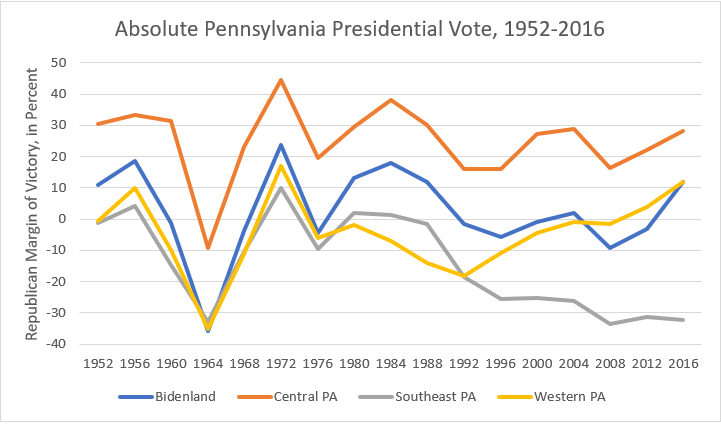
As you can see, in every election from 1952 until 2012, Pennsylvania was more Democratic than the national popular vote, but by six percentage points or less in every year except the 1964 and 1984 landslides.  The 2016 election broke this pattern, as Donald Trump carried Pennsylvania while losing the popular vote nationwide.

This consistency masked a number of changes going on within the state.  Western Pennsylvania, once heavily Democratic, became solidly Republican outside the city of Pittsburgh.  The Philadelphia suburbs, once a Republican stronghold, have become more Democratic.  In the central part of the state, Republicans have increased their margins in rural areas while losing ground in some cities, such as State College, Harrisburg, and Lancaster.  A number of more blue-collar cities, such as Erie and Scranton, seemed to be getting more Democratic, but swung toward Donald Trump in 2016. 

Pennsylvania Regions

The most fundamental division in Pennsylvania’s geography runs along the Blue Mountain, at the eastern edge of the Appalachians.  It crosses the Mason-Dixon line almost halfway across the state’s southern border, near Chambersburg, then runs north of Carlisle, Harrisburg, Lebanon, Reading, and Allentown, roughly following the path of Interstates 81 and 78.  Pike and Monroe counties, in the Poconos, are north of the Blue Mountain, but their proximity to the New York metropolitan area makes their demographics more aligned with the area to their south.  

The area south and east of the Blue Mountain is mostly part of the Piedmont, the area of rolling hills stretching from New York City to Alabama.  It tends to align with the Northeastern cities, mostly with Philadelphia, but in some areas with New York or the Baltimore-Washington region.  Outside of already densely packed Philadelphia and some of its suburbs, its population has grown at an impressive rate for a northern state.  It is relatively affluent.  Politically, it has shifted to the Democrats (especially in the areas around Harrisburg, Lancaster, and the Philadelphia suburbs), but Republican margins have been holding, or even increasing, in the areas around York and Reading (rhymes with “wedding”).

The area north and west of the Blue Mountain is the stereotypical Pennsylvania of coal mines and steel mills.  It tends to identify with the Midwest or Appalachia.  It is not as wealthy as south-central or southeastern Pennsylvania, and, outside of State College and some of the Pittsburgh suburbs, its population is either declining or growing slowly.  It is either part of the Appalachian Mountains or the Allegheny Plateau, the easternmost part of the Mississippi River basin.  Politically, the Democrats used to have a great deal of support here, but it began turning toward the Republicans around the turn of the millennium (there are counties here that voted for Walter Mondale, John McCain, and Mitt Romney), a trend which has accelerated with the rise of Donald Trump.

Population growth by county, 2000-10 (Source: U.S. Census Bureau)

Median household income by county, 2010 (Source: U.S. Census Bureau)


Another way to split Pennsylvania is into four basic regions, one entirely east of the Blue Mountain, one entirely west, and two straddling it.  These regions are:
  • Bidenland, a term coined by Brandon Finnigan of Decision Desk HQ.  This region consists of several small, blue-collar cities (Reading, Allentown, Bethlehem, Scranton, and Wilkes-Barre) in northeastern and east-central Pennsylvania.  The Blue Mountain divides it between the anthracite coal region, stretching from Scranton to Schuylkill County, and a string of exurban areas from Reading to the Poconos.  It tends to be evenly divided in elections, but swung to Trump in 2016.
  • Central PA, the area James Carville had in mind when he described Pennsylvania as “Philadelphia and Pittsburgh with Alabama in between”.  This is the state’s Republican stronghold, and its presence is what keeps Pennsylvania in play for them.  The Blue Mountain divides it between the growing area around Harrisburg, Lancaster, and York, and the more thinly populated Appalachian area.
  • SEPA, or Philadelphia and its “collar counties” (Bucks, Chester, Delaware, and Montgomery).  This is the smallest region by land area, but the largest by population.  In the past, the Republican suburbs balanced the Democratic city, but recently, both have become Democratic strongholds.  Since the mid-20th century, it has held steady at just under a third of the state’s population.
  • Western PA, the most stereotypically “rust belt” region.  It contains the Pittsburgh metro area, as well as Erie and several smaller, blue-collar cities such as Johnstown and New Castle.  Once heavily Democratic, Republicans have made impressive gains here, but its shrinking population is making it less of an asset in statewide elections.
I’ll look at each of these regions in detail, including the sub-regions and trends within each, in subsequent posts.  For now, here is a look at how the four regions voted, both in absolute terms and relative to the national popular vote, showing the trends I’ve mentioned above:


Below is the population of each region, both in absolute terms and as a percentage of the state:


As you can see, Bidenland declined slightly before growing again, as the suburban areas around Reading, the Lehigh Valley, and the Poconos grew, while the southeast has been fairly steady at just under one-third of the state’s population.  Central Pennsylvania has grown steadily, while Western Pennsylvania has declined.


Friday, March 8, 2019

Great Moments in Democratic Rhetorical History

(Cross-posted at Ricochet)

In the matter of Rep. Ilhan Omar, the House Democrats have been criticized for watering down their resolution about her anti-Semitic remarks into a more general condemnation of bigotry, but as you’ll see, that tactic has quite a long history…

Luke 15, House Democratic Standard Version

13 And not many days after the younger son gathered all together, and took his journey into a far country, and there wasted his substance with…well, “riotous” is probably too strong a word, but it wasn’t good.
14 And when he had spent all, there arose a mighty famine in that land; and he began to be in want.
15 And he went and joined himself to a citizen of that country; and he sent him into his fields to feed swine.
16 And he would fain have filled his belly with the husks that the swine did eat: and no man gave unto him.
17 And when he came to himself, he said, “How many hired servants of my father’s have bread enough and to spare, for he hath #FoughtFor15, and I perish with hunger!
18 “I will arise and go to my father, and will say unto him, ‘Father, there has been a lot of sinning against heaven, and before thee, what with the homophobia and the Islamophobia and the transphobia and the anti-Korean sentiment, and I don’t think it would be productive to single anyone out, but there has also been some, shall we say, prodigal spending of your money lately…


July 4, 1776

Let’s be blunt, the world’s kings haven’t exactly been on a winning streak with the inalienable rights lately. Louis XIV was a megalomaniac, and whichever Louis we’re up to this week isn’t much better. The king of Spain has been absolutely brutal in South America. Europe is full of minor kingdoms and duchies, from Lithuania to Tuscany to Frangelico-on-Wienerschnitzel, and if they’re not burning witches, they’re throwing pamphleteers in prison or putting Anabaptists in the stocks. Don’t even get us started on the Czar.
Oh, and we have some problems with King George III. Now, “declaration” is a strong word…

June 4, 1940

At any rate, a lot of different countries- no need to get into specifics just yet- would defend to the death their native soil, aiding each other like good comrades, if the Nazis decided to invade. We doubt they’d get too far if they decided to invade the United States, for instance. Sure, Hitler’s all buddy-buddy with Stalin now, but if he turns on him and invades Russia, I’m sure he’d have a fight on his hands.* Heck, even some of the South American republics would be a lot for him to handle, what with the jungles and the malaria and whatnot. Which brings me to England. As I said, I don’t want to get into details or pigeonhole myself, but I’m thinking something along the lines of blood, toil, and tears, maybe sweat too.
*Spoiler alert!

July 20, 1969: In Event of Moon Disaster

Isn’t it remarkable how many celestial bodies don’t have living human beings on them? Mercury is about eight hundred degrees on a good day, and Venus is covered in boiling sulfuric acid, so they’re ruled out. Other than Mars, the other planets are just gas, so there’s not even a place to land. There might be planets around other stars, but some of them might be transphobic. There are thousands of asteroids and comets, but they’re all too small for life.
So, while we’re on the subject of lifeless bodies in space…

Friday, February 8, 2019

Il Triunfo de Bezos: An Opera in Three Acts


ACT I: Il Donatio de Bezos

Goffredo Bezos, a book merchant who has gotten rich through trade, is in Nuovo Iorco to announce a great gift to benefit its people.  Don Chucco, doge of Nuovo Iorco, sings of Bezos’s generosity toward the city, and notes that he has, at least temporarily, calmed the tension between the Cuomi, Deblasii, and Ghillibrandi over which faction will lead the planned invasion of Nuovo Ampscheria to oust Il Donaldo from the imperial throne. 
A messenger arrives with news that Alessandria, a onetime barmaid of Spanish origin, has overthrown Giuseppe Crolio in the outlying region of Broncsia.  Don Chucco begins rebuking him for his impertinence, until Alessandria shows up and denounces the festivities surrounding Bezos, alleging that the noble families of Nuovo Iorco bribed Bezos to make his donation and that he will bring ruin to the city (“Gentrificazione!  Ipstertopia!  Rento thru il rufo!  Mondo trafico!  Wipipo!”).  Enraged, Lady Nancia, wife of Don Chucco, orders Alessandria exiled to the island of Verde-Nuovo-Deale (“Che proposale vamo nowhere prestissimo!”).  Don Chucco and Lady Nancia apologize profusely to Bezos, who forgives them, but says he must depart for the land of Nova.

ACT II: I Virgini

            Bezos arrives at La Cittia del Cristal in the land of Nova to make another donation.  He is met by Ralfo, a noble Moor who has become king of the Virgini.  Ralfo sings of the previous billionari who have ravaged his land: Il Donaldo, who recently closed the entire land of Nova for three weeks as part of a campaign against the Messicani, and Il Snidero, the worst of all, who destroyed the Redschini.  After Ralfo’s lament, a messenger arrives alleging that Ralfo is not in fact Moorish, but a member of the tribe of Mediscuoli, who, as part of a barbaric ritual from the distant past, often falsely pose as Moors. 
A chorus of Virgini lament the fall of Ralfo (“E buon, tu es un pediatrizione e non dermatologio!”), but express hope that Don Fairfacco, next in line for the throne, will unite the people.  Don Fairfacco is about to take the throne when the Lady Vanessa alleges he has ravished her (“Mitu!  Mitu!  Mitu!”).  Flummoxed, the Virgini offer the throne to Don Marco, only to find out that he has also posed as a Moor.  Ralfo, Fairfacco, and Marco all fall on their swords.  The Virgini attempt to summon their ancient ruler, Giefferzone de Monticello, but even he declines to take the throne (“E super razialle problematico”). 
With no other options, the Virgini offer their kingdom to Bezos, who is about to accept when a messenger arrives saying that the Dicopico, a forgotten but extremely powerful relic, is in the hands of the Enquiereri, a barbarian tribe threatening to use it to overthrow Bezos.

ACT III: La Battalle del Dicopico

The nobles of the empire are gathered at a great feast, where the Patrioti are about to devour the flesh of rams.  Bezos arrives accompanied by the troubadour Tomancso and begins singing an aria about the importance of his work in the land of Nova and the neighboring land of Distritto (“Democracia morte in noche”), before denouncing the scoundrel Peccherio, leader of the Enquiereri, for seeking to destroy him with the stolen Dicopico.  The assembled nobles begin laughing as one at Peccherio’s name, breaking the power of the Dicopico. 
             At the moment of Bezos’s triumph, a messenger from Nuovo Iorco arrives with the news that Alessandria’s power has grown to the point where most of the Presidentabile have made trips to the island of Verde-Nuovo-Deale, and she is once again threatening his interests in the city.  Bezos, now king of the Virgini, determines that he will move his donation from Nuovo Iorco to his new realm.

Saturday, December 29, 2018

Looking Back on 2019

DISCLAIMER: I am not aware of any scientific evidence that multicultural holiday coincidences can cause heads to explode, and I completely condemn any violence or threats of violence against the President.   Also, all speculation about the gender or sexuality of actual or potential Presidential candidates is purely satirical.

I do, however, stand by the assertion that Notre Dame football fans are annoying.


The White House, May 5, 2019 (colorized)
(Cross-posted on Ricochet)

            The year 2019 will be remembered for the tragic demise of President Donald Trump, whose head exploded in May when the first day of Ramadan fell on Cinco de Mayo.  At the time, Washington was anticipating the rollout of the Mueller investigation findings, which were scheduled to be announced on the Jimmy Kimmel show during sweeps week, and Speaker Nancy Pelosi was attempting to keep talk of impeachment under control by grimacing whenever the subject was brought up in her presence. 
            President Mike Pence took office benefitting from public sympathy due to the tragic circumstances of his rise, but inherited an economy that seemed about to head into a recession.  It didn’t help matters when, during what the papers took to calling “Ramagone” or “Cinco de Bye-O”, President Trump’s hair landed in the Potomac, flooding the new Amazon site in Crystal City, Virginia, and forcing Amazon to revise its earnings estimate downward.  By the end of June, the Dow Jones was down three percent for the year.  This inspired Pence, the first Hoosier President since 1893, to give a rousing halftime speech to the markets in the Wall Street locker room and order his economic team to switch from a 2-3 zone to a man-to-man defense, sparking a rally that has brought the Dow close to the 28,000 mark.  At year’s end, Pence and Vice President Nikki Haley (Pence’s initial choice was Treasury Secretary Steven Mnuchin, but he backed down after realizing nobody could pronounce “Mnuchin”) have a modest but steady lead in the polls to win a term in their own right next year.
            The race for the Democratic nomination seemed hopelessly muddled after the initial frontrunner, former Vice President Joe Biden, had to drop out after a #MeToo scandal with then-Sen. Amy Klobuchar (surprisingly, Klobuchar was the instigator).  During the early part of the year, Robert Mueller, Colin Kaepernick, Kathy Griffin, Ruth Bader Ginsberg, “Whatsername”,  and Gritty (the Philadelphia Flyers mascot) all led in polls at some point.  In September, New Jersey Sen. Cory Booker came out of the closet and jumped to the lead in every poll.  He seemed set to sweep the primaries until Beto (as she was then known) O’Rourke announced the first week of November that she was transitioning to live as a woman and wished to be called “Beta”.  Then, resolving a feud that had dogged the Democrats since the beginning of the year, Beta O’Rourke and Bernie Sanders announced they were engaged and seeking to have a co-presidency.  The press inevitably called the new power couple “Berta”.  The race is now largely between Booker and Berta, although some pollsters believe Gritty is in a good position in the Super Tuesday states.
            Internationally, the year will be remembered for the partial resolution of crises rocking the Middle East and Europe.  By the spring, the antics of then-Saudi Crown Prince Muhammad bin Salman were even alienating supporters such as President Trump, who (shortly before passing to the Great Trump Tower in the Sky) tweeted that the United States was ready to pivot to Jordan as its closest Arab ally, adding that he was impressed with Jordan’s adroit diplomacy in handling Dennis Rodman.  MBS was pushed out in August using allegations of an inappropriate relationship with a scorpion as a pretext and replaced with his cousin, Salman bin Muhammad.  SBM then announced a plan to transition Saudi Arabia to democracy by incorporating every Saudi citizen into the royal family by 2035.  The American pullout from the former nation of Syria did not destabilize the region as much as feared, although concerns that Turkey was gaining too much influence in the country only increased when it was renamed “Stuffing” the week before Thanksgiving.  An Israeli offensive against Lebanese Hezbollah stalled after the Israelis invaded Lebanon, New Hampshire, by mistake and began leading in New Hampshire primary polls.
            In Europe, negotiations over Brexit stalled after the governments of both Angela Merkel and Theresa May lost votes of confidence and collapsed.  Germany is now under an interim caretaker government consisting entirely of middle-aged blond men in large glasses and mustaches named “Gunther”, which agreed to give Queen Elizabeth the right to veto any EU regulations in Britain by declaring them to be “bollocks on stilts” until a permanent Brexit agreement can be reached.  Britain also agreed to the free movement of people and goods across its border with the Republic of Ireland in exchange for the Irish admitting in writing that Notre Dame football fans are annoying.  The replacement of May with Prime Minister Boris Johnson fueled speculation that the  worldwide populist movement was really about elevating leaders with unkempt blond hair, which only grew after Angela Merkel purchased a Van de Graaff generator, sparking talk she is plotting a comeback.
            China was unusually quiet, but by the end of the year, elements within the Chinese government were suggesting that it could claim any land within 500 feet of a Chinese restaurant as sovereign territory.
            2019 was an eventful year for sports and entertainment, beginning with Super Bowl LIII, which the Los Angeles Rams won over the Kansas City Chiefs after Chiefs quarterback Patrick Mahomes, while attempting to pass in midair, sprouted wings and flew away.  In movies, Christian Bale won the Best Actor Oscar for his portrayal of Dick Cheney in Vice, leading to Cheney briefly leading in Democratic primary polls, which in turn led to speculation that polls are being answered sarcastically.  Avengers: Endgame came out, revealing (SPOILER ALERT!) that the entire Marvel Cinematic Universe was the fever dream of a deaf-mute Belgian art student who, while attempting to hitchhike to Los Angeles, had eaten gas-station sushi in Kentucky.  The Golden State Warriors won the NBA championship again, after which Steph Curry announced he was retiring from basketball to run for President.  He led in the polls until Michigan Sen. Gary Peters, in a debate, asked him why he doesn’t call himself “Steve” like a normal Stephen.
          The media event of the year may be the surprising emergence of former House Speaker Paul Ryan as one of the nation’s most beloved TV personalities.  It began after Sean Hannity entered a monastery after President Trump's memorial service, leading Fox News to reshuffle its lineup, which ended with Ryan hosing “Fox and Friends”.  The other highlight is the revival of The Weekly Standard, which went out of business in late 2018 and seemed permanently doomed after its founder, Bill Kristol, turned out to be three marmosets stacked on top of each other wearing a suit.  However, at year’s end, former first lady Melania Trump had bought the rights to relaunch the magazine, which she is expected to use as a springboard to run for governor of New York in 2022.

Tuesday, December 18, 2018

The Case for a Cage Match in 2019

(Cross-posted at Ricochet)

This past weekend, I had an idea that is harebrained even by my standards, and now I'm going to subject you to it.  Here's why, and how, a Nicolas Cage for President boomlet should happen in 2019.  

Like this, but in Iowa.

Before you think I've gone completely off the deep end, I don't mean that Cage should actually be elected President, or even run.  I mean that he should publicly toy with the idea to the extent that Nicolas Cage presidential chatter dominates the news cycle for a few days, some pollster starts asking people if they would vote for him, and one of the actual candidates rants at him online or at a rally (obviously, this would most likely be a series of enraged Trump tweets, but I wouldn't count out Joe Biden).

It would be highly entertaining.  It would be the most on-brand thing possible for Nicolas Cage, for Presidential politics, and for the year 2019*.

He wouldn't have to do much to gin up media speculation- just schedule a couple trips to Iowa and New Hampshire, comment publicly about a couple political issues, do some charity work, and most importantly, have a bunch of people ask him to run on Twitter and reply coyly to them.  I'm sure Gary Sinise could use a hand with his next project for veterans, and you could probably hire a consultant and a few dozen Twitter bots for less than the cost of a castle in England, "the most haunted house in America" in New Orleans, or a dinosaur skull, all of which Cage has actually bought (spending habits which would fit in quite well in the federal government).

He'd probably run as a Democrat, since they're the ones with an open primary and I assume that any actor leans left until proven otherwise.  The most entertaining scenario would be for Cage to consider running as a Democrat but threaten to go third-party if he doesn't get his way, like Donald Trump with the GOP in 2015, but the idea of a primary challenge to Trump is growing on me.  If John Kasich runs, the combination of Cage's facial expressions and Kasich's fruit ninja abilities could prove formidable.

It's time, America.  It's time to turn to a man who is not at all qualified to be President, but eminently qualified to be the subject of presidential speculation.  It's time to go from draining the swamp to stealing the Declaration of Independence.  It's time to Make America Cagey Again.

*Admittedly, the year 2019 hasn't happened yet, but I'm assuming that it will be even more 2018-like than 2018, which seems pretty safe.

Wednesday, September 20, 2017

With Deepest Apologies to Elton John


Generals packed my bags last night, pre-flight
Zero hour, nine A.M.
And I'm gonna be all over the news by then
I miss the earth so much, and caviar
It's lonely out in space
On such a timeless flight
 
And I think it's gonna be a long long time
'Till Donald brings me round again to find
I'm not the god they think I am at home
Oh no no no, I'm a rocket man
Rocket man, only fat guy in his whole country

And I think it's gonna be a long long time
'Till Donald brings me round again to find
I'm not the god they think I am at home
Oh no no no, I'm a rocket man
Rocket man, only fat guy in his whole country

Guam ain't the kind of place to raise your kids
In fact, it's wet as hell
Rodman isn't there to raise them if you did
And all this science I don't understand
I just kill them if they screw up
A rocket man, a rocket man

And I think it's gonna be a long long time
'Till Donald brings me round again to find
I'm not the god they think I am at home
Oh no no no, I'm a rocket man
Rocket man, only fat guy in his whole country

And I think it's gonna be a long long time...